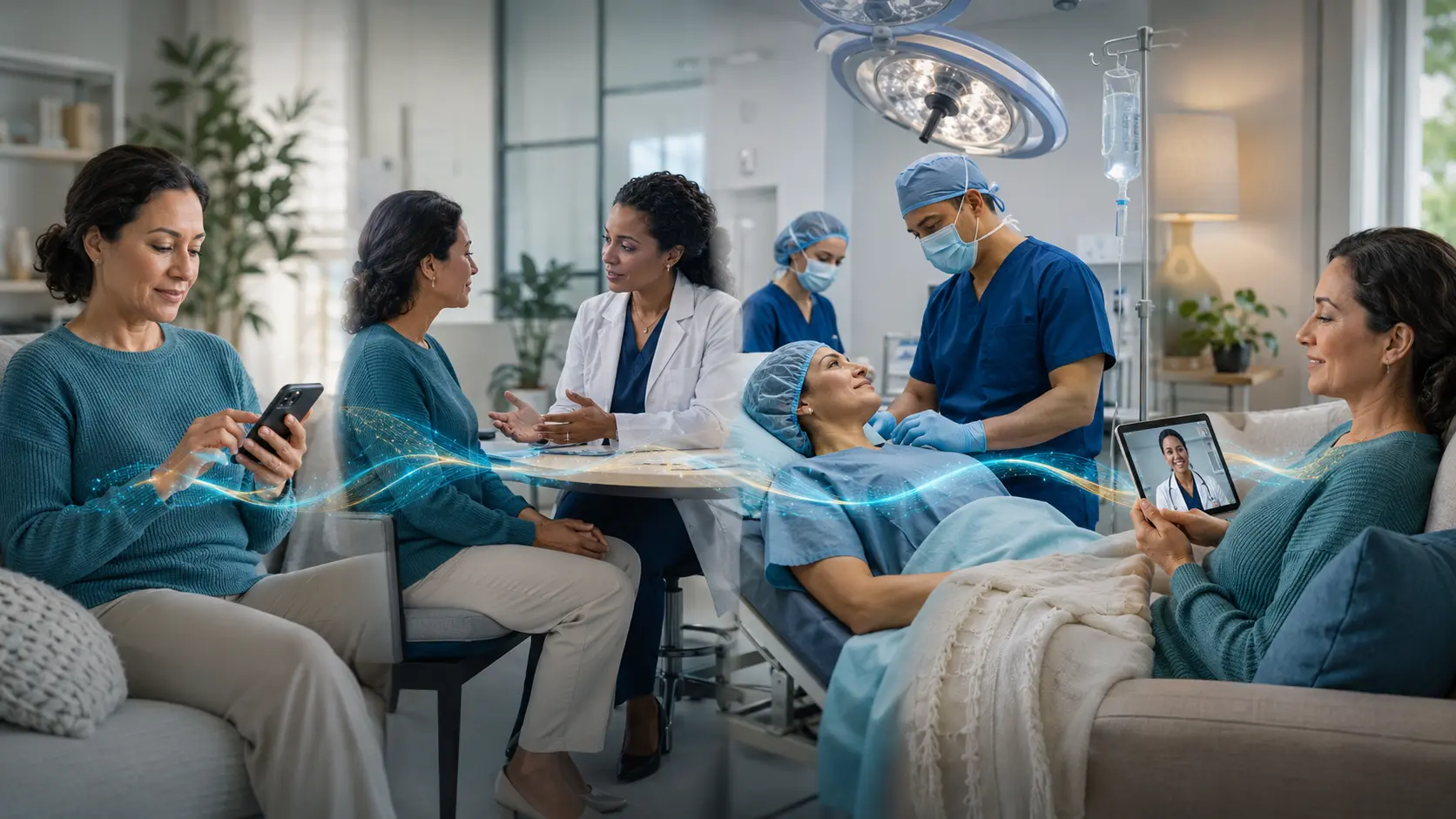
Eight connected clinical applications share one secure patient and encounter record — from intake and specialty care through surgery, billing and recovery.
PatientTrac connects the people, workflows and clinical information surrounding one patient journey. Each application is purpose-built for its job while the patient record stays connected across the network.
PatientTrac fits multi-specialty groups and single-specialty clinics alike — wherever a patient moves across schedulers, specialists, procedures, billing, and follow-up.
Multi-specialty medical groups
Ambulatory surgery centers
Behavioral & neurobehavioral health
Aesthetic & cosmetic surgery practices
Perioperative & procedural teams
Practices modernizing a legacy EMR
One patient journey. The applications change with the work; the patient and encounter record remain connected.
The Network Architecture
Six ideas hold the whole network together.
Every capability below sits on the same clinical data layer. Nothing is bolted on.
01
One secure data layer
A single clinical repository is the source of truth for every application — no duplicate charts, no re-keyed records.
One patient and encounter record shared across all apps
Row-Level Security enforced on every table
Organization-level multi-tenant isolation between practices
Tamper-evident, hash-chained PHI audit trail
02
The encounter_id key & cross-app launch
One universal encounter key lets clinicians move between specialty apps on the same visit without losing context.
A single encounter_id links scheduling, documentation, and billing
Cross-app launch carries the patient and encounter with you
No duplicate entry when a visit spans specialties
The record follows the patient from intake to recovery
open_encounter() mints the encounter_id; checkin_and_route() resolves the provider's specialty and launches the correct app
03
Connected specialty apps
Each application is purpose-built for its specialty and speaks the same shared record.
Profiler intake and Companion recovery bookend the visit
Mind, Revela, Continuum & ASC for procedural and specialty care
New specialties join the network without a new database
04
Server-side AI with guardrails
AI assists the clinical and billing workflow — always for human review, never as an autonomous decision-maker.
Model API keys remain server-side, never in the browser
AI-assisted summaries, drafts, alerts, and suggestions for clinician review
Clinical decisions remain with licensed professionals
Patient-facing AI is non-diagnostic and non-prescriptive
Concrete examples — no-show prediction, smart scheduling, streaming operative-note drafts, rating-scale safety alerts — all for clinician review
05
Compliance & interoperability
Concrete mechanisms — not marketing labels — carry protected health information safely and portably.
TOTP multi-factor authentication and role-based access
ROI and accounting-of-disclosures workflows
C-CDA generation and EHI export for portability
Standards-based claims (X12 837P) and ERA/835 posting
DEA controlled-substance ledger (21 CFR §1304.21, Form 222) and RTM documentation (CPT 98975-98981)
06
Multilingual, multi-site, multi-specialty
The same connected experience scales across languages, locations, and disciplines.
End-to-end EN / ES / FR across patient- and provider-facing surfaces
Multiple locations under one tenant, isolated per organization
Specialty-aware forms without a separate system per clinic
License-gated scale as you add providers and sites
How it connects
The shared record is the whole point.
A patient scheduled in Forge flows into intake, the specialty encounter, the procedure record, billing, and post-visit monitoring — all bound by one encounter_id, all writing back to the same clinical spine.
Forge
Patient management, scheduling & revenue-cycle hub — the source of the encounter_id every other app consumes.
Ambulatory surgery center operations — real-time visibility across cases, rooms, supplies, and revenue.
Real-time live case console · DEA controlled-substance ledger (21 CFR §1304.21, Form 222) · preference-card case costing · supplies & equipment tracking
Perioperative & procedural documentation — one record for the whole episode, pre-op to recovery, tied back to the encounter.
Pre-op · intra-op · recovery in one record · owns the anesthesia record the network reads · streaming AI operative note · registry-readiness (NSQIP, GIQuIC, AJRR, SVS VQI)
Intelligence and compliance are stated as mechanisms, not promises — what the platform actually does, and where the human stays in control.
Server-Side AI · Clinician Review
How AI works here
AI-assisted summaries, drafts, alerts, and suggestions for clinician review; API keys remain server-side; clinical decisions remain with licensed professionals.
Patient-facing AI in Companion is non-diagnostic and non-prescriptive, grounded in the care plan, routes patients to the care team, and directs emergencies to local services.
Concrete Mechanisms
How PHI is protected & moved
Row-Level Security on every table, a hash-chained PHI audit, TOTP multi-factor authentication, server-side keys, organization-level tenant isolation, ROI and accounting-of-disclosures, C-CDA generation, and EHI export.
Revenue-cycle workflows support standards-based claim generation (X12 837P), ERA/835 posting, and documentation completeness; they support billing workflows and do not guarantee reimbursement.
Why it's different
Not a suite of apps. A network.
Most vendors either force every specialty into one generic screen or sell a bundle of tools that never truly share data. PatientTrac does neither: purpose-built applications sit on a single clinical spine, bound by one encounter_id, with server-side AI and concrete compliance mechanisms woven through — multilingual, multi-site, and multi-specialty from the first record to the last. Founded in 1998, it was rebuilt cloud-native for exactly this.
Concretely: one encounter_id from Forge's router carries the patient into Profiler's specialty-adaptive intake, Revela's chairside iPad drawing and PROMs, Mind's longitudinal rating-scale engine, ASC's live case console and DEA ledger, Continuum's owned anesthesia record, and Companion's RTM-aligned recovery — each writing back to the same clinical repository, none of it re-keyed.
See the network on your own patients.
Walk a real encounter from intake to billing across the connected apps, and see the shared record move with the patient.