
PatientTrac Companion | Reimbursement Series
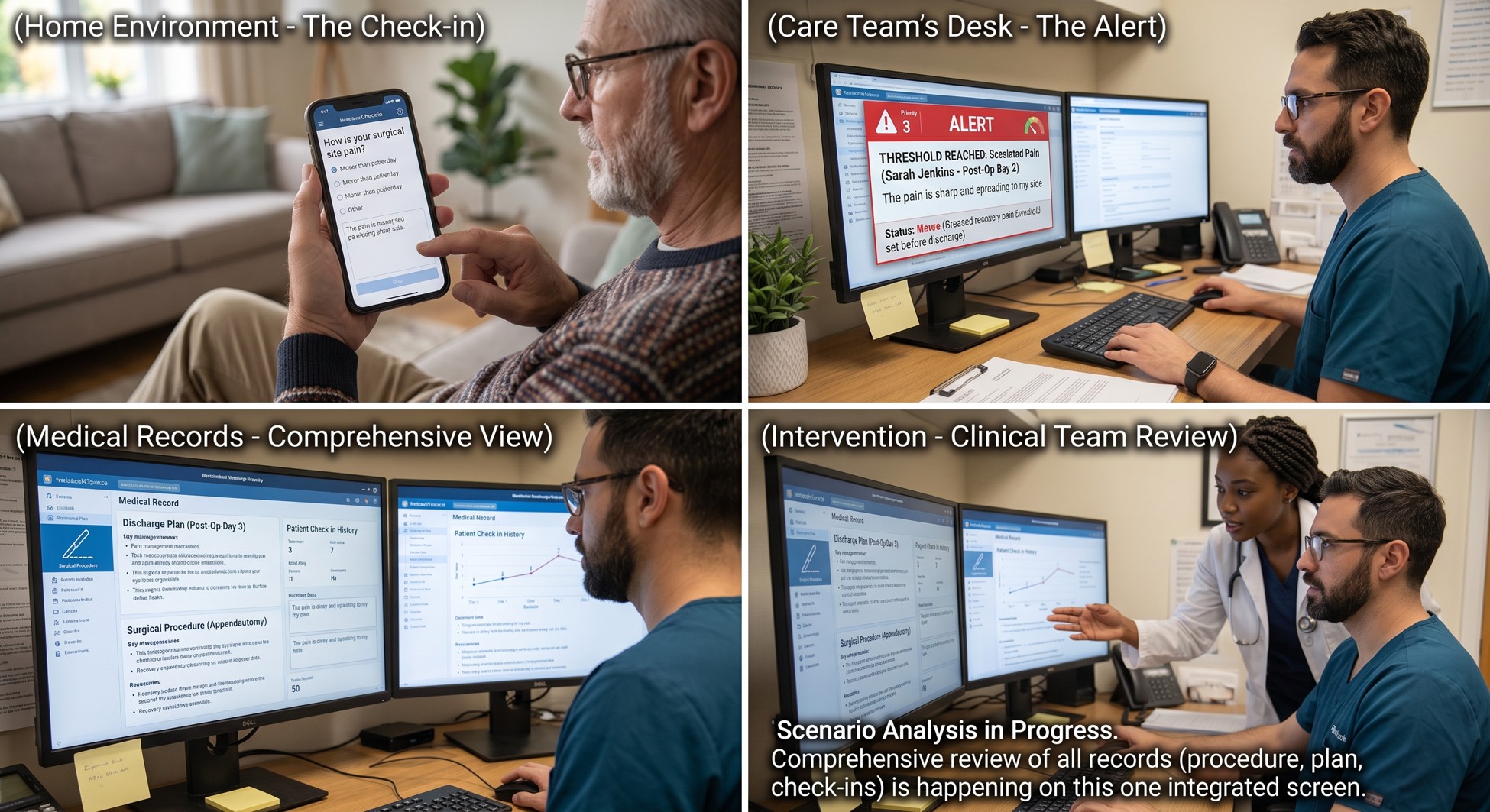
The patient takes a reading on a drugstore blood-pressure cuff at the kitchen table. The display reads 132 over 84. She opens her recovery app and types the two numbers into a field, then taps "slightly dizzy." On the care team's screen, the entry looks exactly like device data.
That typed number is patient-reported data, but Medicare's remote physiologic monitoring codes pay only when a device sends the reading itself.
CMS describes remote patient monitoring as the collection of physiologic data—such as blood pressure, weight, or oxygen saturation—using a connected medical device that automatically transmits the data to the health care provider. Medicare policy has also clarified that RPM device data must be electronically collected and transmitted rather than self-reported. For 2026, the longer-duration CPT 99454 pathway remains tied to 16–30 days of device data, while a separate short-duration code, CPT 99445, addresses 2–15 days.
That rule binds every practice that bills RPM, regardless of the app in the patient's hand. A reading typed from a separate cuff breaks the chain the code requires, because no device transmitted it. The number can still be clinically useful. It cannot support an RPM device claim.
Many remote-care products blur this line in their marketing. A symptom diary gets described as monitoring, and monitoring gets described as billable. A practice that believes it and bills manual entries as RPM takes on the audit risk itself.
PatientTrac Companion as it stands today should be described plainly. Manual symptom, medication, and wellbeing entries support care documentation, ePRO programs, and care management. They do not by themselves create an RPM claim. A legitimate RPM pathway requires integration with qualifying connected devices such as blood-pressure cuffs, scales, and pulse oximeters, and that integration is Companion's next build, not a current feature.
Saying so costs a sales conversation or two. It also keeps every other claim Companion makes believable when a compliance officer reads it.
The patient at the kitchen table did everything asked of her. Whether her next reading counts as monitoring now depends on a cable, a Bluetooth pairing, and a decision the practice has not yet made.
Primary Sources
Explore the Remote Care Perspectives Series
- Section overview
- 1. "Does Medicare Pay for This App?" Is the Wrong Question
- 2. What $110 a Month Actually Buys in Oncology
- 3. CMS Requires ePROs but Doesn't Pick Your Vendor
- 4. The 2 A.M. Call
- 5. Why Typing Your Symptoms Isn't Remote Monitoring
- 6. The Short-Burst Recovery Window
- 7. Minutes Are Money, If You Can Prove Them
- 8. Canada: Ten Provinces, Ten Rulebooks
- 9. The NHS Doesn't Bill. It Commissions.
- 10. Reimbursement as a Feature, Not a Promise