
PatientTrac Companion | Reimbursement Series
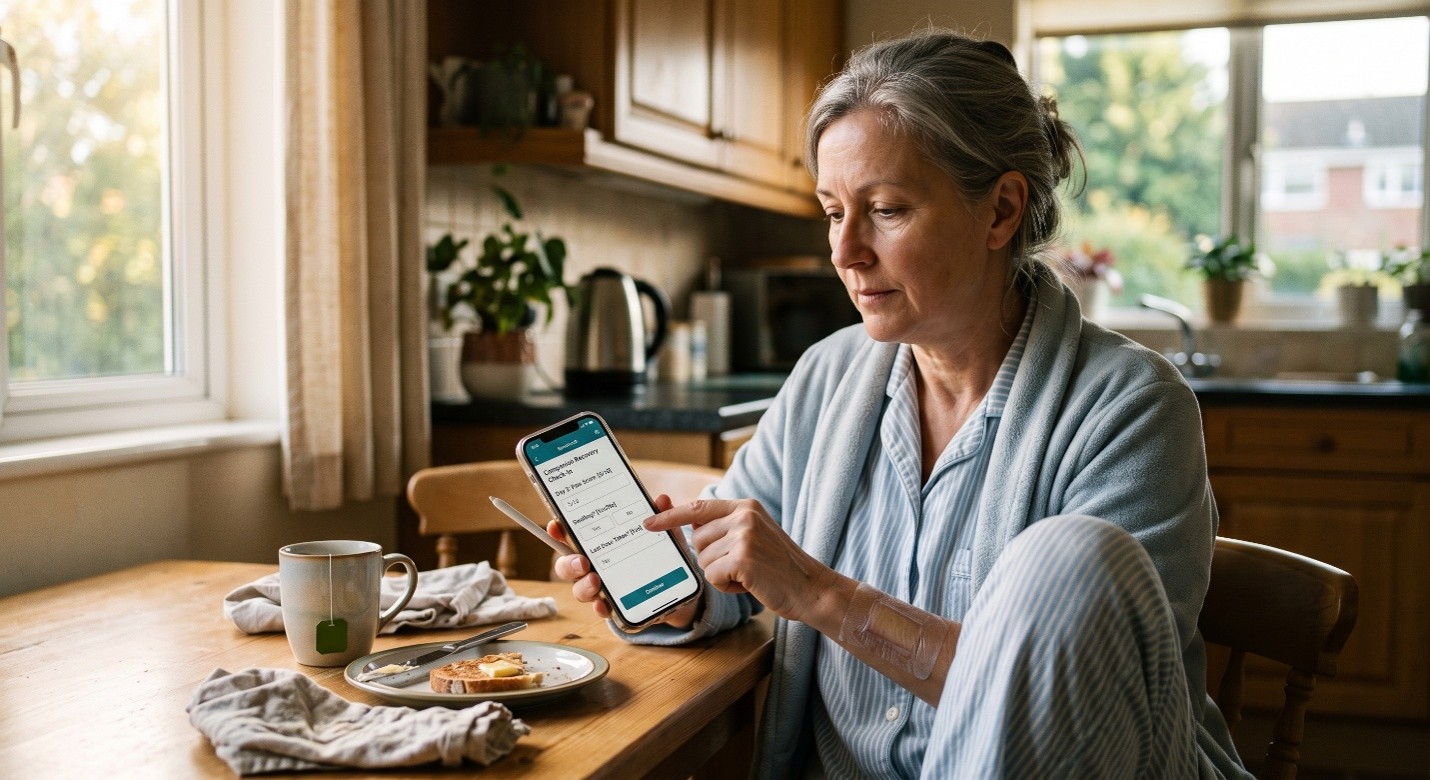
The triage nurse has three windows open. The portal questionnaire shows a pain score of seven, entered Tuesday night. A phone message slip from Wednesday morning says the patient is "feeling better." The EHR progress note mentions neither. Three records describe the same patient, and none of them references the others.
That pain score of seven is an electronic patient-reported outcome, and EOM practices are required to collect scores like it.
CMS's EOM guide describes collecting and monitoring electronic patient-reported outcomes as one of eight required participant redesign activities. The agency leaves the tool open: CMS does not require a specific ePRO tool, but participants must use tools that capture outcomes across defined domains where applicable.
The evidence behind the requirement is specific. On June 4, 2017, Ethan Basch and colleagues published trial results in JAMA. 766 participants starting chemotherapy for metastatic solid tumors were randomized to usual care or to a web-based PRO questionnaire platform, with an email alert sent to a clinical nurse whenever a severe or worsening symptom was reported. Median overall survival was 31.2 months in the PRO group and 26.0 months with usual care. Patients in the intervention group could also stay on chemotherapy longer: 8.2 months versus 6.3 months.
The mechanism in that trial was the alert reaching a nurse, not the questionnaire itself. That finding applies to every practice collecting ePROs, whatever software it runs. A score that sits unread in a portal reproduces the survey part of the trial and leaves out the part that produced the benefit.
Most practices today collect ePROs in one of three ways: an EHR patient-portal questionnaire, a standalone ePRO platform, or paper transcribed later. Each can capture the score. The weak point is usually the hand-off, where the score, the nurse's response, and the chart note live in separate places.
PatientTrac Companion is designed to close that hand-off. The patient answers in Companion, a threshold flags the care team, and the response and outcome are exported into the EHR as one record. The nurse's three windows become a single trail.
CMS left the vendor choice to each practice. What each practice now has to decide is whether its chosen tool can show that someone acted on the seven.
Primary Sources
- CMS — EOM Electronic Patient-Reported Outcomes Guide
- CMS — EOM Quality, Health Equity, and Clinical Data Strategy webinar transcript
- Basch et al., JAMA (2017) — Overall survival with electronic symptom monitoring
- Basch et al., Journal of Clinical Oncology (2016) — Randomized symptom-monitoring trial
Explore the Remote Care Perspectives Series
- Section overview
- 1. "Does Medicare Pay for This App?" Is the Wrong Question
- 2. What $110 a Month Actually Buys in Oncology
- 3. CMS Requires ePROs but Doesn't Pick Your Vendor
- 4. The 2 A.M. Call
- 5. Why Typing Your Symptoms Isn't Remote Monitoring
- 6. The Short-Burst Recovery Window
- 7. Minutes Are Money, If You Can Prove Them
- 8. Canada: Ten Provinces, Ten Rulebooks
- 9. The NHS Doesn't Bill. It Commissions.
- 10. Reimbursement as a Feature, Not a Promise