Care that stays with the patient.
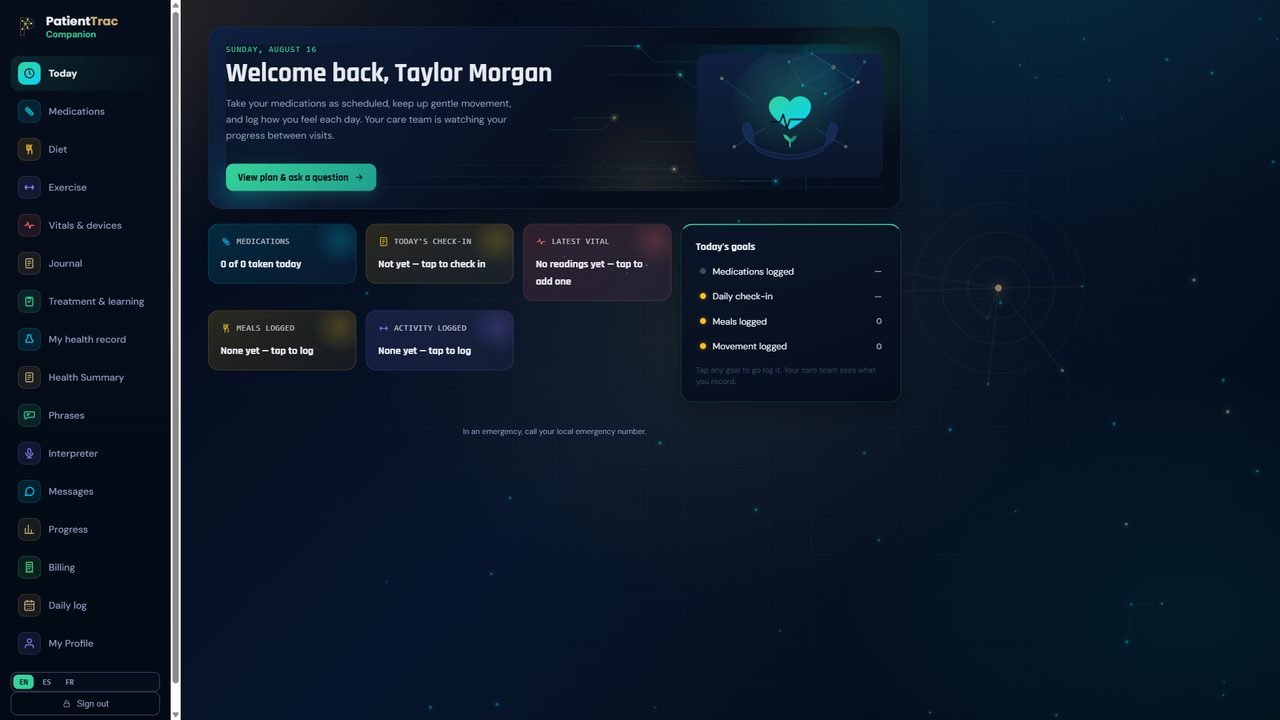
Companion is the patient's mobile connection to the PatientTrac network — available now on Apple iOS and Google Android. Patients arrive prepared, understand their coverage and authorization status, follow their care plan, share supported vitals, and recover with structured 30/60/90-day check-ins and a guardrailed Ask AI.
For patients and families — connected to the practices that care for them.
Download the mobile app
PatientTrac Mobile is live on Apple's App Store and Google Play. Install the version for your phone, then pair it with the secure code from your participating practice.


A pairing code from your PatientTrac practice is required.
Before the visit, through recovery — in the patient's pocket
Prepared before the visit
Companion turns the days before an appointment into preparation instead of uncertainty. Patients see their upcoming visits, complete what the practice needs from them, and can supply insurance authorization details they already hold — which land in Forge's verification queue for staff to confirm. Companion shows authorization status; it never declares payer approval on its own.
- Upcoming appointments with clear preparation steps
- Coverage and authorization status, visit by visit
- Patient-supplied authorization details routed to Forge for staff verification
- Read-only status — verification always happens in Forge
- English, Spanish, and French throughout
The daily plan
The care team's plan becomes the patient's day: medications with schedules, tasks, and instructions, organized so that what matters today is obvious. Patients log what they did, and the practice sees adherence as it happens rather than at the next visit.
- Care plan tasks organized by day
- Medication schedules with logging
- Instructions from the care team in plain language
- Adherence visible to the practice
- Secure messaging with the care team
Supported vitals & monitoring
With the patient's permission, Companion brings supported vitals and activity readings — available through the patient's device and platform permissions — into the care record, alongside manually logged measurements. The care team sees trends where they matter: attached to the patient, not trapped in an app.
- Supported vitals and activity readings via device and platform permissions
- Manual measurement logging
- Trends visible to the care team
- Patient-controlled permissions
- Readings tied to the shared patient record
Structured recovery & Ask AI
After a procedure, Companion runs a structured recovery: scheduled check-ins across the 30, 60, and 90-day arc, symptom reporting the care team actually reviews, and Ask AI — a guardrailed assistant that helps patients understand their instructions and their plan. Ask AI is non-diagnostic, stays within the care team's guidance, and is never a substitute for the practice or for emergency services.
- 30/60/90-day structured recovery check-ins
- Symptom reporting reviewed by the care team
- Guardrailed Ask AI for understanding instructions
- Non-diagnostic by design — care questions go to the practice
- Clear direction to contact the practice or emergency services when appropriate
From "your visit is scheduled" to "you've recovered"
Connect
The practice invites the patient; Companion links them to their own record at that organization.
Prepare
Appointments, preparation steps, and coverage and authorization status — clear before the day of the visit.
Follow the plan
Medications, tasks, supported vitals, and messages — the care plan lived daily, visible to the care team.
Recover
Structured 30/60/90 check-ins and symptom reporting until the episode closes — with Ask AI to help understand the instructions.
Who Companion serves
Patients
One place for your visits, your plan, your medications, and your recovery — in your language, on your phone.
Care teams
See adherence, supported vitals, and recovery reports as they happen — and reach patients without phone tag.
Practices
Fewer surprises at check-in, authorization details supplied ahead of time, and recovery episodes that stay on protocol.
Ask AI: helpful within limits — by design
Ask AI helps patients understand what their care team already told them: instructions, preparation steps, the recovery plan, and what their medications schedule means in practice. It is deliberately guardrailed — non-diagnostic, grounded in the patient's own plan, and consistent in directing clinical questions to the practice. It never provides emergency services and clearly says so.
Companion supports patients between visits. It does not diagnose, does not replace the care team's judgment, and is never a substitute for urgent or emergency care — patients are directed to their practice or to emergency services whenever that is the right answer.
The network, from the patient's side
Companion shows the appointments and authorization status Forge maintains, carries the plans clinicians document in Mind and Revela, continues the recovery Continuum and ASC prepared, and complements the intake Profiler collected. It is the same shared record the practice works on — seen from the patient's side of care.
See a recovery run on rails
In a guided demonstration we will connect a patient, walk the pre-visit preparation, and run a recovery episode — check-ins, supported vitals, and Ask AI included.
Request a Demo