Where the clinical network runs.
Forge is the operational center of the PatientTrac network: registration, scheduling, schedule-linked insurance preauthorization, check-in, encounter creation and routing, EDI claims, remittance, denials, and accounts receivable — one operational truth from the first phone call to the final payment.
For front desk, schedulers, billing teams, revenue managers, and practice administrators.
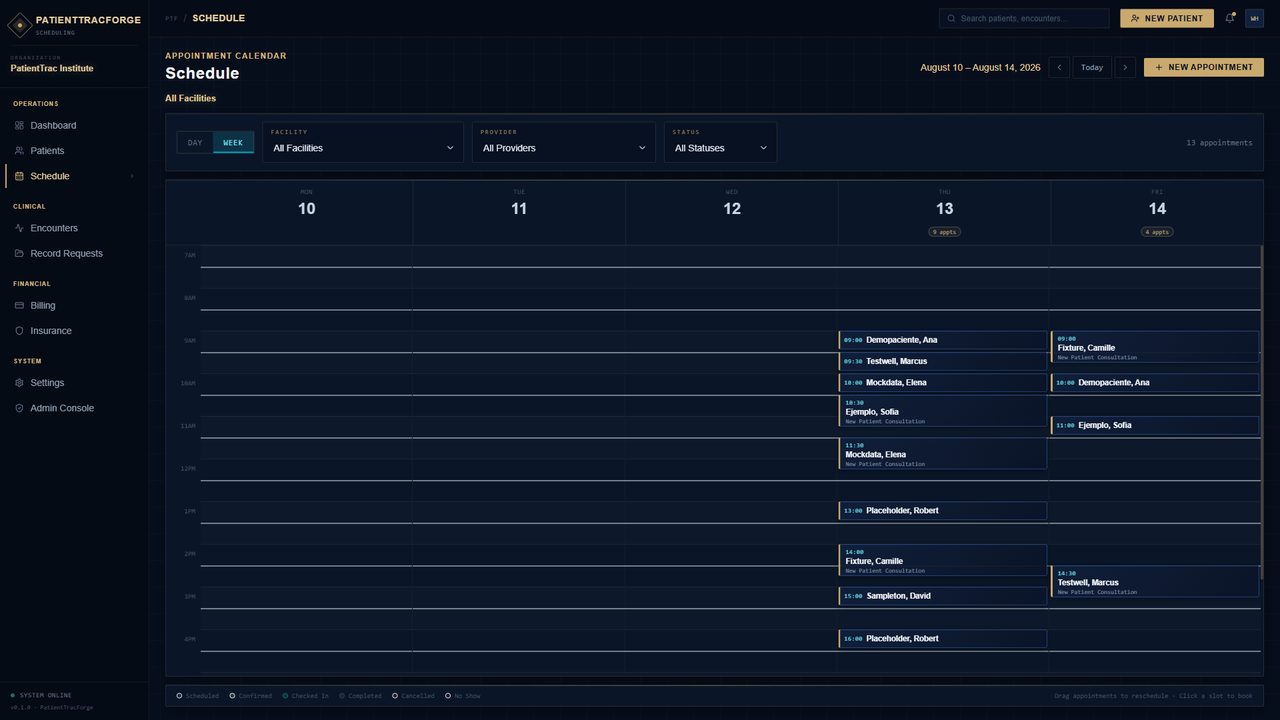
Operations and revenue on one shared record
Scheduling & the front desk
Forge owns the master schedule for the organization: providers, rooms, facilities, and visit types across every site. The front desk registers patients, books against real availability, checks patients in, and routes each visit to the right clinical application — and because Forge creates the encounter, everything that follows is anchored to one identity.
- Master scheduling across providers, rooms, and sites
- Patient registration and demographic management
- Check-in and day-of-visit workflow
- Encounter creation and routing to clinical applications
- Visit types, recurring appointments, and follow-ups
Schedule-linked preauthorization
Authorization work lives where it belongs — on the schedule. When an appointment, laboratory order, or imaging order needs payer authorization, Forge raises a readiness flag rather than blocking the booking. Billing staff work a dedicated queue that captures authorization numbers, effective dates, and approved units, so the practice sees exactly what is cleared before the date of service and what still needs attention.
- Coverage capture with payer preauthorization contacts
- Automatic readiness flags on appointments and orders
- Authorization numbers, dates, and approved units on record
- A worked queue — flags resolved by billing staff, never silently
- Patient-visible status in Companion, verified only in Forge
Claims & electronic billing
Reviewed encounter documentation becomes billing work without re-keying. Forge assembles charges from the clinical record, supports professional claims in the EDI 837P format, and receives electronic remittance advice (ERA/835) so payments post against the same encounters the claims came from.
- Charge capture from reviewed encounter documentation
- Professional claims in the EDI 837P format
- Electronic remittance advice (ERA/835) intake
- Payment posting reconciled to encounters
- Patient statements and balance management
Denials, A/R & revenue work
Revenue is a set of queues, worked deliberately. Forge organizes denials with reasons and appeal tracking, ages accounts receivable so nothing quietly stalls, and keeps the working history of every claim — who touched it, what changed, and what happens next.
- Denial management with reasons and appeal tracking
- Accounts receivable aging and follow-up queues
- Claim status history and audit trail
- Payer and plan management
- Revenue visibility by provider, site, and service line
From first call to final payment
Register & schedule
Register the patient, capture coverage, and book against real provider, room, and site availability.
Clear the visit
Preauthorization flags rise automatically where payers require them; billing staff clear the queue before the date of service.
Run the encounter
Check the patient in and create the encounter that the clinical applications document against.
Bill & collect
Assemble charges, submit 837P claims, post ERA/835 remittance, and work denials and A/R to resolution.
Who works in Forge
Front desk & schedulers
One schedule that reflects reality — providers, rooms, and sites — with registration, check-in, and encounter routing in the same motion.
Billing & authorization teams
A preauthorization queue tied to the schedule, claims built from reviewed documentation, and denials organized into workable lists instead of surprises.
Administrators & revenue managers
Visibility across the whole cycle — what is booked, what is cleared, what is billed, what is paid, and what is stuck — by provider, site, and service line.
AI that prepares revenue work — people who own it
Forge applies assistive intelligence where billing teams lose the most time: organizing encounter documentation into draft charges, identifying claims likely to need attention before submission, summarizing denial patterns, and prioritizing follow-up queues. Every claim, appeal, and adjustment is reviewed and submitted by qualified staff — AI in Forge prepares the work; it never acts on its own.
Forge supports billing and revenue operations. Claims are prepared with assistive tooling and are reviewed, approved, and submitted by qualified billing staff — Forge does not submit claims autonomously, and authorization status is verified by people, not inferred by software.
The operational spine of the network
Forge schedules against the sites and providers Hub defines, receives Profiler's reviewed intake ahead of the visit, and creates the encounters Mind, Revela, Continuum, and ASC document against. Reviewed documentation returns to Forge as billing work, and Companion shows patients the appointment and authorization status Forge maintains. One schedule, one encounter, one revenue truth.
See Forge run a real day of clinic
In a guided demonstration we will book a patient, clear the authorization, run the encounter, and follow the claim through remittance — on one shared record.
Request a Demo