The surgery center, run as one operation.
ASC is the operational system of the ambulatory surgery center: the day's cases across rooms and teams, inventory and sterile processing, controlled-substance accountability, and the utilization and case-economics picture that tells you whether the center is actually working.
For ASC administrators, charge nurses, materials and sterile processing teams, and owners.
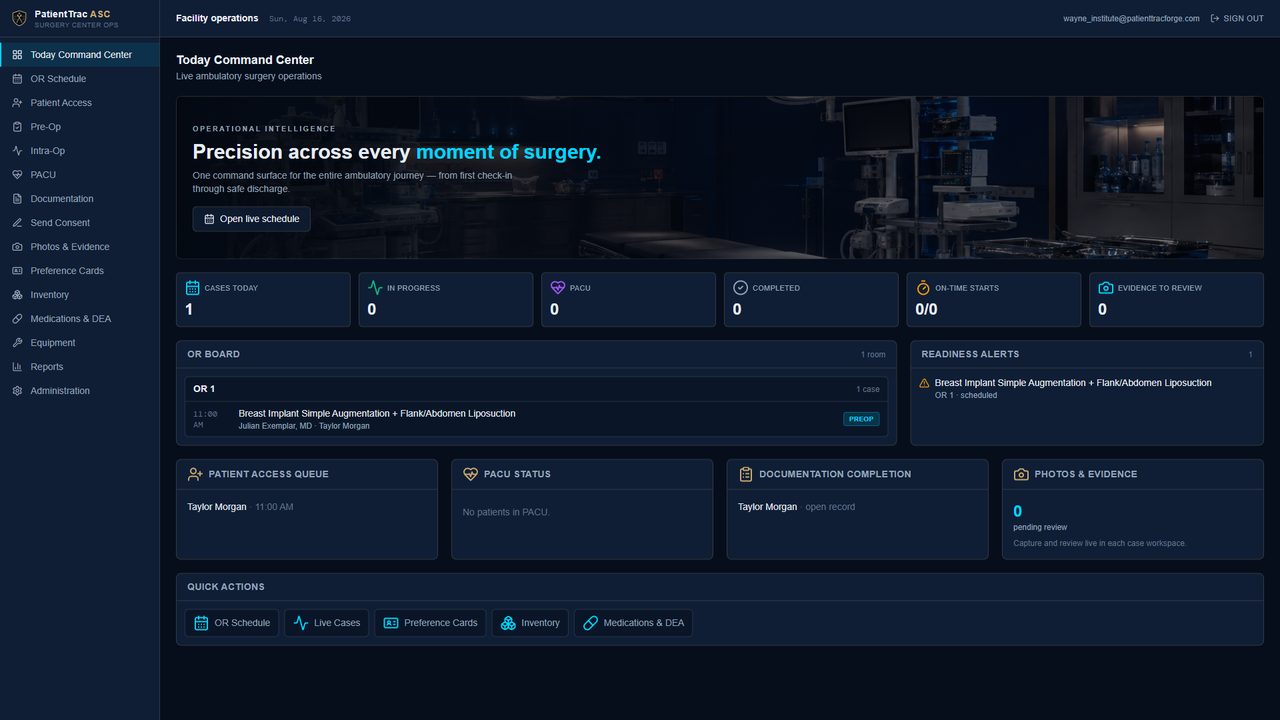
The facility floor, the supply chain, and the numbers
Cases, rooms & rosters
The surgical day is a coordination problem, and ASC is where it gets solved: cases sequenced across rooms, teams rostered to the cases they staff, status visible as the day moves, and delays surfaced while there is still time to act — a live floor view instead of a whiteboard.
- Case scheduling and sequencing across rooms
- Team rosters assigned per case
- Live case status through the surgical day
- Room turnover visibility
- Coordination with Forge scheduling and the clinical record
Inventory & sterile processing
Cases consume materials, and materials have histories. ASC tracks the supplies and implants the center stocks, what each case consumed, and the sterile processing cycle — instrument sets moving through decontamination, sterilization, and storage with the documentation that work requires.
- Supply and implant inventory tracking
- Case-level consumption capture
- Sterile processing cycle documentation
- Instrument set tracking through the cycle
- Reorder visibility before shortages reach the schedule
Controlled-substance accountability
Controlled substances demand documentation that stands up to scrutiny. ASC records controlled-substance custody and administration at the facility — what was dispensed, administered, wasted, and returned, by whom and with witness — structured to support the center's regulatory accountability obligations.
- Dispensing, administration, waste, and return documentation
- Attribution with witness recording
- Custody records at the facility level
- Discrepancies surfaced for human review
- Documentation structured to support regulatory accountability
Utilization & case economics
A surgery center is also a business, and ASC keeps the numbers where the operations are: room and block utilization, case volumes and durations, and the cost side of each case from captured consumption — so decisions about the schedule, the staff, and the supply contracts rest on the center's own data.
- Room and block utilization
- Case volumes and durations over time
- Case-level cost from captured consumption
- Views by surgeon, room, and procedure type
- The operational picture owners actually ask for
A surgical day, coordinated
Build the day
Cases sequenced across rooms with teams rostered and materials confirmed before the first patient arrives.
Run the floor
Live status as cases move — starts, turnovers, and delays visible while they can still be managed.
Account for everything
Consumption captured per case; controlled substances documented with attribution and witness; sterile processing cycles recorded.
Read the numbers
Utilization and case economics from the day the center actually ran — not a spreadsheet reconstructed later.
Who works in ASC
Administrators & charge nurses
The whole day on one screen — cases, rooms, teams, and status — with the authority to act while it still matters.
Materials & sterile processing
Inventory that matches reality, consumption captured at the case, and processing cycles documented as they run.
Owners & partners
Utilization and case economics from operational data — the basis for decisions about blocks, staffing, and contracts.
Operational clarity, prepared for the people running the floor
ASC's assistive intelligence organizes the operational picture: summarizing the day ahead, identifying schedule pressure and material shortfalls before they become delays, and prioritizing what the administrator should look at first. Discrepancies — in counts, in consumption, in controlled-substance records — are surfaced for human review, never resolved silently by software.
ASC supports facility operations and accountability documentation. Clinical decisions belong to the surgical and anesthesia teams, and regulatory compliance determinations belong to the center's responsible staff — ASC documents and surfaces; people decide and answer.
The facility side of the surgical day
ASC coordinates the day Continuum documents: ASC owns the rooms, teams, materials, and economics, while Continuum owns the clinical record of each procedure. Cases arrive from Forge scheduling with encounters already created, readiness documented in Revela travels with the patient, and what the case consumed flows into the center's cost picture. One surgical day — the facility side and the clinical side, each done properly.
See a surgical day run on one system
In a guided demonstration we will build a day of cases, run the floor, capture consumption and controlled-substance documentation, and read the utilization numbers at the end.
Request a Demo